Radon Mitigation in Pittsburgh, PA: How the Marcellus Shale and Allegheny County's Housing Stock Create a Hidden Risk
Pittsburgh sits on the Appalachian Plateau over Pennsylvanian-age shale and Marcellus Shale — both documented radon sources. 35.8% of tested Allegheny County homes exceed EPA's 4.0 pCi/L action level. Average tested level: 3.2 pCi/L. Mitigation cost: $950–$2,400 for active sub-slab depressurization. All work must be performed by DEP-certified professionals.
Pittsburgh's radon risk is routinely underestimated. The city's EPA Zone 2 classification — "moderate potential" — creates a false sense of security that does not survive contact with the testing data. Over one in three Pittsburgh-area homes exceeds the EPA action level. The geological source is different from the Reading Prong crisis in eastern PA, but the outcome is the same: radioactive gas accumulating in basements at concentrations that warrant professional mitigation.
What makes Pittsburgh's situation distinct is the interaction between geology and housing stock. The Marcellus Shale provides a diffuse but persistent radon source, and Allegheny County's large inventory of pre-1960 homes — built with porous foundations, no vapor barriers, and unfinished basements — maximizes the entry rate of whatever soil gas is present. The city's cold winters amplify the problem through the stack effect, making winter radon levels significantly higher than summer readings.
Why Pittsburgh Has Elevated Radon
The Marcellus Shale Connection
Pittsburgh and the surrounding Allegheny County sit on the Appalachian Plateau, underlain by a sequence of Pennsylvanian and Devonian-age sedimentary rocks. The most significant radon source in this sequence is the Marcellus Shale — a Middle Devonian black shale formation rich in organic carbon and naturally elevated concentrations of uranium-238.
The Marcellus is the same formation targeted by the natural gas industry. The uranium that makes it a valuable gas reservoir also makes it a persistent radon source. As uranium-238 decays through the chain to radium-226 and then radon-222, the gas migrates upward through overlying rock and soil into the built environment.
Unlike the Reading Prong — where concentrated uranium in fractured granite produces extreme point-source radon flux — the Marcellus delivers radon more diffusely across a broad geographic area. Individual soil gas concentrations are lower, but they are consistent and widespread. This is why Pittsburgh's 35.8% exceedance rate, while lower than Reading's 58.7%, still represents a serious public health exposure across a much larger population base.
For a deeper analysis of how the Marcellus Shale and other Pennsylvania formations produce indoor radon, see our geology post.
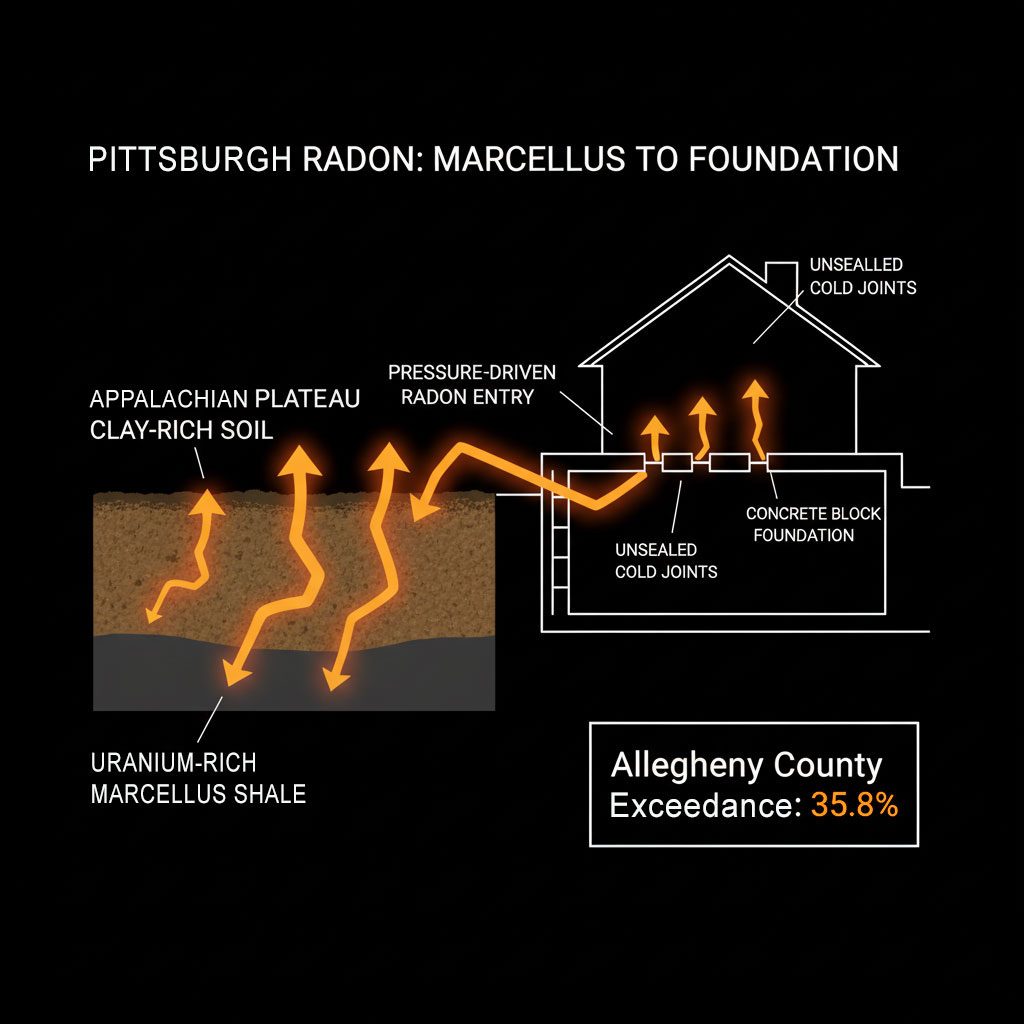
The Marcellus-Foundation interface. Naturally occurring uranium in the Marcellus Shale generates radon, which migrates through the Appalachian Plateau soil to enter Pittsburgh homes through porous block foundations.
The Appalachian Plateau Shale Sequence
Above the Marcellus, the Appalachian Plateau in Allegheny County includes additional Devonian and Pennsylvanian-age shales, siltstones, and thin coal seams — all of which contain varying concentrations of naturally occurring radioactive materials. The weathering of these rocks produces the clay-rich soils that characterize much of western PA. These soils have moderate gas permeability: they don't transmit radon as efficiently as the fractured granite of the Reading Prong, but they transmit enough to sustain indoor concentrations well above the action level in homes with permeable foundations.
Pittsburgh's Housing Stock: The Amplifier
Geology provides the source. Housing construction determines the entry rate. Allegheny County's built environment is heavily weighted toward pre-1960 construction with characteristics that maximize radon intrusion:
Porous foundations. Many Pittsburgh-area homes — particularly in neighborhoods like Squirrel Hill, Bloomfield, Lawrenceville, and the South Side — were built with concrete block or stone foundations that are significantly more gas-permeable than modern poured concrete. Mortar joints in block walls, gaps around utility penetrations, and unsealed slab-to-wall cold joints all provide direct entry pathways for soil gas.
No vapor barriers. Homes built before the 1970s rarely include sub-slab vapor barriers. The concrete slab sits directly on soil or gravel fill, and radon diffuses through the slab's pores in addition to entering through cracks and joints.
Unfinished basements. Pittsburgh's older homes frequently have unfinished basements with exposed concrete or dirt floors. These spaces are often connected to the home's HVAC system or used as living space, directly exposing occupants to basement-level radon concentrations.
The stack effect in Pittsburgh winters. When a Pittsburgh home is heated to 68°F while outside temperatures drop to 20°F or below, the stack effect generates significant negative basement pressure. This pressure differential actively draws soil gas through the foundation. Winter radon levels in Pittsburgh homes can be two to three times higher than summer readings — a seasonal swing that means a home testing at 3.0 pCi/L in July might test at 6.0 or higher in January.
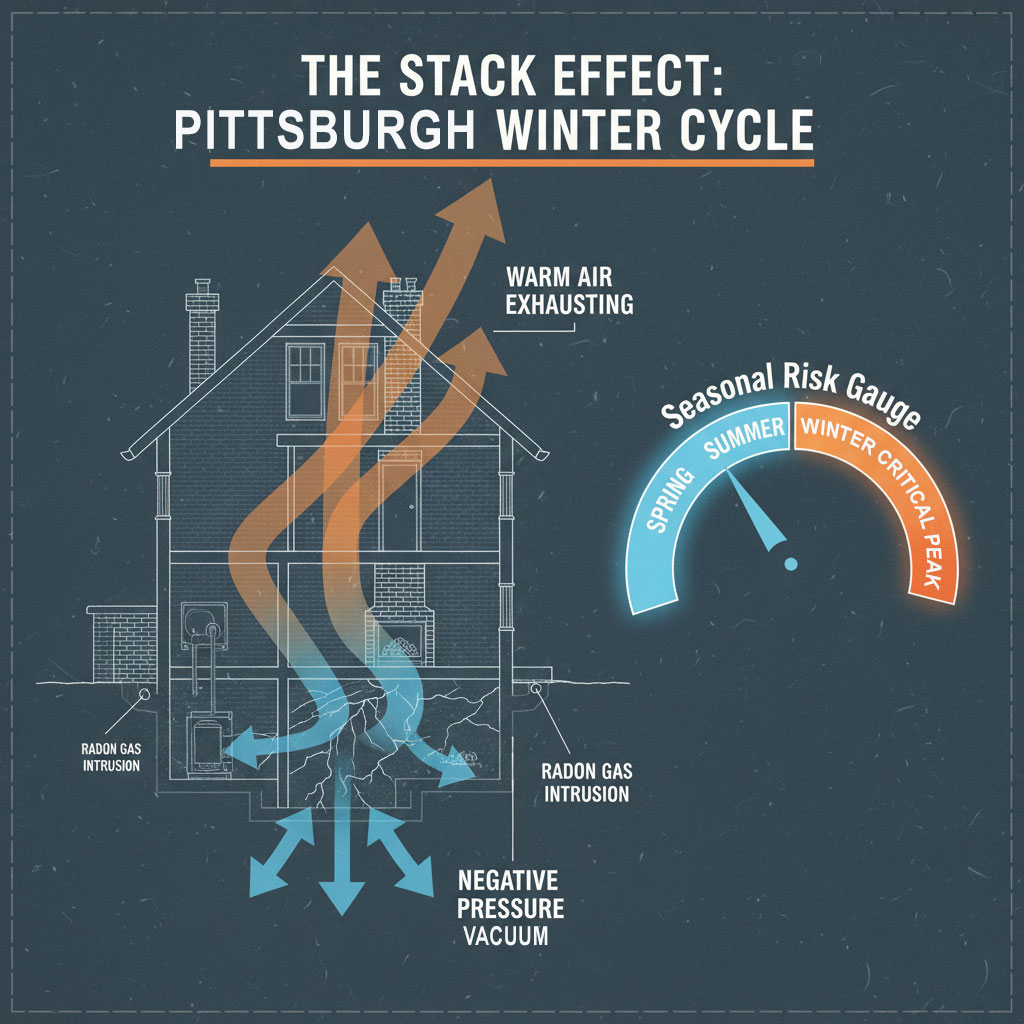
The Pittsburgh Stack Effect. In winter, warm air rising through the building creates a vacuum in the basement, drawing radon from the soil into living spaces at rates significantly higher than in summer.
Radon Risk Across Pittsburgh's Neighborhoods
Allegheny County's geology is not uniform, and neither is its radon risk. While the 35.8% county-wide exceedance rate applies broadly, specific neighborhoods and communities have distinct risk profiles.
The Mon Valley and South Hills
Communities along the Monongahela River valley — including Homestead, West Mifflin, Clairton, and the South Hills suburbs — sit on Pennsylvanian-age shale and coal-bearing rock. The industrial and mining history of the Mon Valley means that portions of the subsurface have been disturbed by coal mining, creating fracture networks and void spaces that can alter radon transport patterns. Homes in these areas should be tested regardless of their apparent condition or age.
East End Neighborhoods
Squirrel Hill, Point Breeze, Shadyside, and Regent Square contain a mix of large pre-war homes and mid-century construction. The older homes in these neighborhoods — many built between 1900 and 1940 — have stone or block foundations with the highest radon entry potential. The larger footprints of some of these homes also mean that a single suction point may not provide adequate pressure field extension across the full foundation, potentially requiring multi-point ASD systems.
North Hills and North Shore
Communities north of the Allegheny River — including Ross Township, McCandless, and the North Hills corridor — sit on slightly different geology than the city proper, with more glacially influenced soils overlying the Appalachian Plateau shale. These soils can have variable gas permeability, creating localized radon hot spots even within neighborhoods that test moderate on average.
Western Suburbs
Communities like Moon Township, Robinson Township, and Upper St. Clair — closer to the Washington County line — sit over geology that transitions toward thicker Pennsylvanian-age rock sequences. Washington County is Zone 1 (highest potential), and homes in the western Allegheny County suburbs nearest the county line may have elevated risk reflecting that transition.
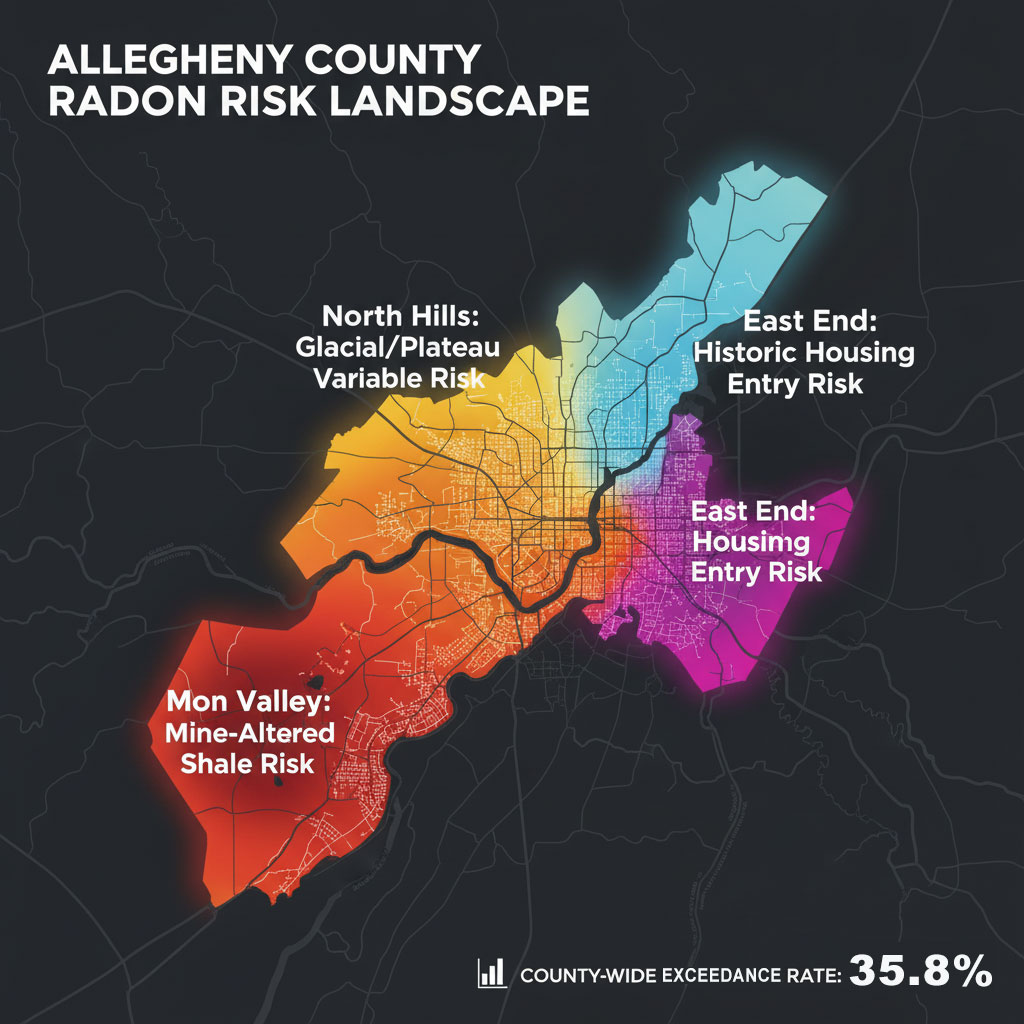
Allegheny County risk landscape. Geological variations—from mine-altered industrial zones to historic urban neighborhoods—create localized radon hotspots that defy county-wide average estimates.
What Radon Mitigation Costs in Pittsburgh
Active sub-slab depressurization systems in the Pittsburgh area typically cost $950 to $2,400, depending on:
Foundation type. Poured-concrete basements (common in post-1960 construction) are the simplest and cheapest to mitigate — typically $950–$1,500 with a single suction point. Concrete-block foundations add $200–$500 for block wall sealing or depressurization. Stone foundations in pre-1920 homes are the most complex.
Home size. Homes under 2,000 square feet with simple rectangular footprints typically need one suction point. Pittsburgh's larger pre-war homes — common in Squirrel Hill, Point Breeze, and the South Hills — may require two or three suction points at $200–$400 each to achieve full pressure field coverage.
Pipe routing. Unfinished basements allow interior pipe routing (cheapest). Finished basements require exterior routing up the building wall, adding $100–$300. Pittsburgh's steep hillside lots can complicate exterior routing and add to installation labor.
System type. Standard ASD is the most common. Crawlspace encapsulation with sub-membrane depressurization is needed for homes without basements — more common in older communities along the rivers. For details on how system type affects installation, see our ASD engineering standards guide.
SB 760 and Allegheny County Schools
Senate Bill 760 mandates radon testing in all Pennsylvania public school buildings beginning in the 2026-2027 school year. For the Pittsburgh School District and surrounding Allegheny County districts:
Testing scope. Every existing school building must be tested within one year of the law's effective date. Testing must follow ANSI-AARST MA-MFLB protocols and be performed by individuals certified under the Radon Certification Act.
Expected impact. With a 35.8% home exceedance rate in Allegheny County, a significant percentage of school buildings — particularly older buildings with below-grade classrooms and inadequate ventilation — can be expected to test above 4.0 pCi/L. Buildings exceeding the action level must be mitigated within six months of confirmatory testing.
The Pittsburgh School District operates over 50 school buildings, many dating to the early and mid-20th century. The district should anticipate substantial testing and mitigation requirements under SB 760, particularly for buildings with basement-level occupied spaces.
For comprehensive SB 760 compliance details — deadlines, reporting requirements, and mitigation standards — see our Pennsylvania Radon Compliance 2026 guide.
Real Estate and Radon in Pittsburgh
Pittsburgh's real estate radon landscape differs from eastern PA. Allegheny County does not have the same deeply ingrained radon testing culture as Berks, Lehigh, or Centre counties. Key differences:
No seller disclosure mandate specific to radon testing. Pennsylvania's Seller's Property Disclosure Law (68 Pa.C.S. § 7304) requires disclosure of known test results and existing mitigation systems, but it does not require sellers to test. In Pittsburgh, radon testing during real estate transactions is less common than in the Lehigh Valley or Centre County — which means many homes change hands without ever being tested.
This is a gap, not a safety signal. The fact that radon testing is less common in Pittsburgh real estate does not mean radon levels are lower. It means the data is less visible. The 35.8% exceedance rate is based on voluntary testing — the actual prevalence may be higher because the homes most likely to be tested are those where owners already suspected a problem.
At a median home price of $185,000, Pittsburgh buyers should insist on a radon test as part of the home inspection process. If results exceed 4.0 pCi/L, negotiate mitigation costs ($950–$2,400) into the purchase agreement. For sellers: proactive testing and mitigation before listing removes a contingency risk and demonstrates property stewardship.
How to Test for Radon in Pittsburgh
Short-term testing (48–96 hours). A charcoal canister or continuous radon monitor placed in the lowest livable floor — typically the basement. Closed-house conditions must be maintained for 12 hours before and during the test per ANSI-AARST protocols. Best conducted during the heating season (November–March) when the stack effect is strongest and radon levels peak.
Long-term testing (90+ days). Alpha-track detectors or electronic continuous monitors like the Airthings View Plus provide a more accurate annual average. Given Pittsburgh's significant seasonal variation — winter levels 2–3x summer levels — long-term testing gives a more representative exposure picture.
Critical note for Pittsburgh homeowners: a summer test result below 4.0 pCi/L does not guarantee year-round safety. If your result is between 2.0 and 4.0 pCi/L during warm months, retest during winter or deploy a continuous monitor to capture the seasonal peak.
Nearby Cities: Regional Radon Context
Pittsburgh's Marcellus Shale and Appalachian Plateau geology extends across western and central PA:
- Erie — Erie County, Zone 2. Glacial till over Appalachian Plateau shale; 29.6% exceedance rate. Cold-climate stack effect is extreme.
- State College — Centre County, Zone 1. Different geology (Ordovician karst limestone) but the highest exceedance rate in PA at 68.5%.
- Harrisburg — Dauphin County, Zone 2. Triassic Lowland/Blue Ridge transition; 33.4% exceedance.
- Allentown — Lehigh County, Zone 1. Reading Prong/limestone karst dual geology; 51.2% exceedance.
Connecting you with DEP-certified professionals serving Allegheny County. We are an independent resource and do not perform testing or mitigation.
View Pittsburgh Providers →
PA Radon Hub is an independent informational resource. We do not perform radon testing or mitigation. We connect homeowners and institutions with independent, DEP-certified radon professionals. Always verify contractor certifications through the PA Department of Environmental Protection before hiring. EPA action level: 4.0 pCi/L. Costs and availability vary by contractor and property conditions.