The Geology of Indoor Radon: Why the Reading Prong and Marcellus Shale Drive Pennsylvania's Radon Crisis
Pennsylvania's radon crisis is geological. Three bedrock systems — the uranium-rich Reading Prong granite, radium-bearing Ordovician karst limestone, and gas-permeable Marcellus Shale — produce the highest indoor radon concentrations in the eastern United States. Over 40% of PA homes exceed EPA's 4.0 pCi/L action level. Geology determines risk at the county, neighborhood, and individual lot level.
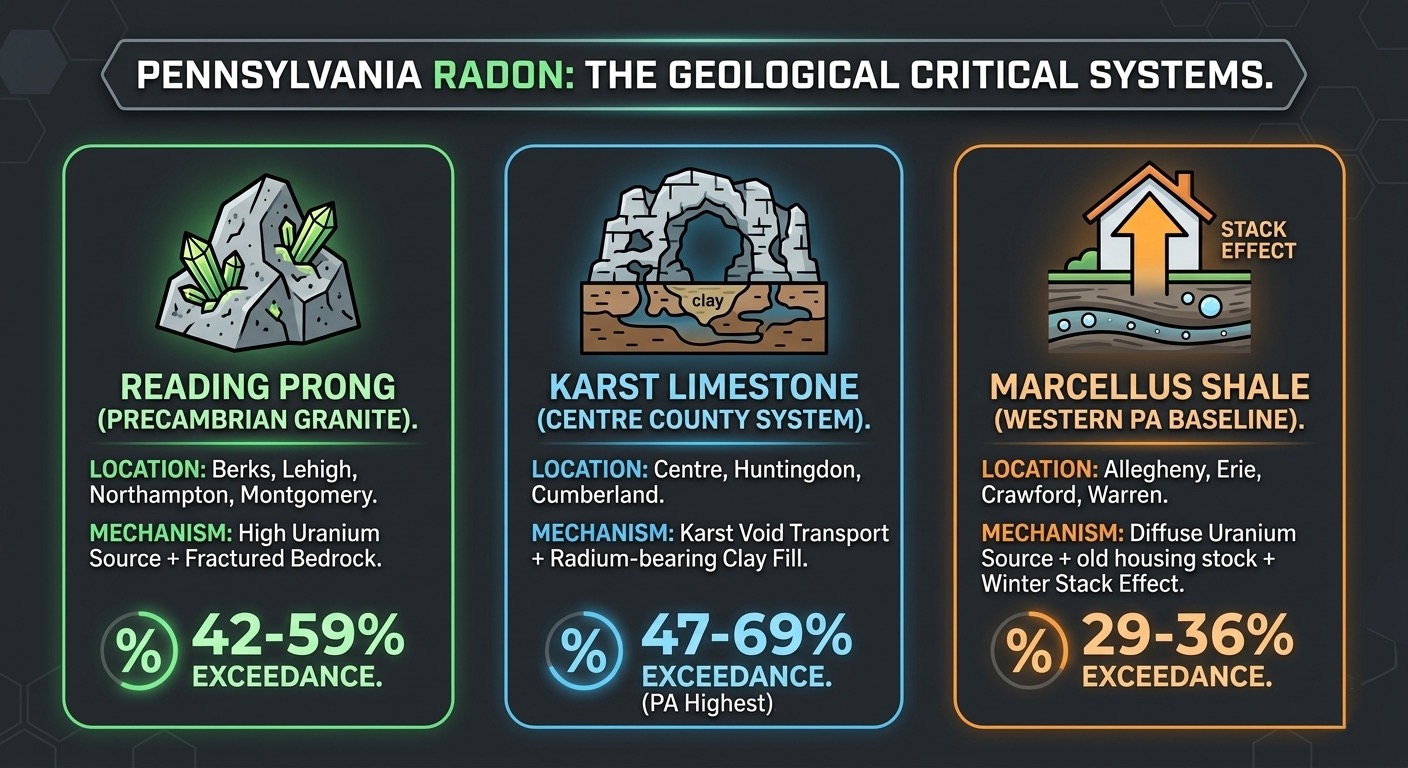
Pennsylvania's primary radon-producing geological systems. Exceedance rates vary by formation, with the Centre County karst system and Reading Prong representing the highest risk zones in the state.
Pennsylvania is not uniformly dangerous for radon. The state's indoor radon problem is a direct consequence of specific bedrock formations, each with distinct mineralogy, fracture characteristics, and soil gas transport properties. Understanding which formation underlies your home — not just your EPA zone — is the single most important factor in predicting radon risk.
This article maps Pennsylvania's five primary radon-producing geological systems, explains the physics of how each drives soil gas into buildings, and connects formation-level geology to the county-by-county testing data that defines the state's risk landscape.
| Formation | Age | Primary Counties | Exceedance Range | Primary Mechanism |
|---|---|---|---|---|
| Reading Prong (granite/gneiss) | Precambrian | Berks, Lehigh, Northampton, Montgomery | 42–59% | High uranium source + fractured bedrock |
| Ordovician Karst (limestone/dolomite) | Ordovician | Centre, Huntingdon, Cumberland | 47–69% | Karst void transport + radium-bearing clay fill |
| Marcellus Shale | Devonian | Allegheny, Erie, Crawford, Warren | 29–36% | Diffuse uranium + old housing stock + stack effect |
| Great Valley Carbonates | Cambrian-Ordovician | Cumberland, Lebanon, Dauphin | 33–47% | Moderate carbonate radium + karst transport |
| Coal Basins (anthracite/bituminous) | Pennsylvanian | Luzerne, Lackawanna, Schuylkill | 30–34% | Mine-altered fracture networks + shale uranium |
How Radon Forms: The Uranium-238 Decay Chain
Radon-222 is not manufactured or released by human activity. It is a naturally occurring radioactive gas produced by the decay of uranium-238, which is present in virtually all rock and soil — but in vastly different concentrations depending on the parent rock's mineralogy.
The relevant decay sequence is: uranium-238 (half-life: 4.5 billion years) → thorium-234 → protactinium-234 → uranium-234 → thorium-230 → radium-226 (half-life: 1,600 years) → radon-222 (half-life: 3.8 days).
Radium-226 is the immediate parent of radon-222. Because radium is slightly soluble in groundwater and tends to concentrate along grain boundaries and fracture surfaces in rock, it is the radium content of the near-surface geology — not just the uranium content of the deep bedrock — that most directly determines how much radon gas is available to enter a building.
Radon-222's short half-life (3.82 days) means it must be produced close to the building envelope and transported rapidly through soil or rock to reach indoor air before it decays. This is why geology matters at an extremely local scale: two homes on the same street can have dramatically different radon levels if one sits over a fracture zone and the other over intact bedrock.
Pennsylvania's Five Radon-Producing Geological Systems
Pennsylvania's geology is among the most complex in the eastern United States, spanning formations from the Precambrian (over 1 billion years old) to the Quaternary (less than 2.6 million years old). Five distinct geological systems drive the state's indoor radon problem.
1. The Reading Prong: Precambrian Granite and Gneiss
The Reading Prong is the single most significant radon source formation in Pennsylvania and arguably in the entire eastern United States. It is a physiographic section of the New England Upland province, extending from southeastern Pennsylvania through northern New Jersey to the Hudson Highlands of New York.
Lithology. The Reading Prong is composed primarily of Precambrian granitic gneiss, quartzite, and metamorphosed sedimentary rocks ranging from 1.0 to 1.3 billion years old (Grenville-age). The granitic gneiss contains elevated concentrations of accessory minerals — principally zircon, monazite, and uraninite — that host uranium and thorium in their crystal structures.
Why it produces extreme radon. Three factors converge in the Reading Prong:
The parent rock has uranium concentrations significantly above the continental crustal average. Multiple orogenic events (Grenville, Taconic, Acadian, Alleghenian) have produced pervasive fracture networks that serve as high-permeability conduits for radon migration. And in much of Berks, Lehigh, and Northampton counties, the residual soil mantle overlying the bedrock is thin — often less than 10 feet — providing minimal attenuation of radon flux from the rock surface to building foundations.
Testing data. The Reading Prong's impact is visible in every city built on it:
- Reading (Berks County): 58.7% exceedance rate, 5.1 pCi/L average — the geological epicenter
- Kutztown (Berks County): 56.1% exceedance, 4.9 pCi/L — university town on core Reading Prong granite
- Allentown (Lehigh County): 51.2% exceedance, 4.4 pCi/L — Reading Prong transitions into limestone-dolomite karst
- Bethlehem (Northampton County): 49.8% exceedance, 4.3 pCi/L — Reading Prong/Lehigh Valley limestone contact zone
- Pottstown (Montgomery County): 48.9% exceedance, 4.2 pCi/L — southeastern extension of the Prong
- Easton (Northampton County): 46.7% exceedance, 4.0 pCi/L — Delaware River limestone transition
- Philadelphia (Philadelphia County): 42.3% exceedance, 3.8 pCi/L — Piedmont transition from Reading Prong influence
The Stanley Watras case. The Reading Prong is where American residential radon awareness began. In 1984, Stanley Watras, a construction engineer at the Limerick Generating Station in Montgomery County, triggered radiation alarms at the nuclear plant before it had been fueled. The source was his home, built on Reading Prong geology. His basement tested at over 2,700 pCi/L — roughly 675 times the EPA action level. The incident led to the EPA's first national radon survey and directly catalyzed Pennsylvania's Radon Certification Act (Act 43 of 1987).
2. Ordovician Karst Limestone and Dolomite: The Centre County System
Central Pennsylvania's karst landscape produces the highest individual home radon concentrations in the state — including the single highest county-level exceedance rate.
Lithology. The bedrock is Ordovician-age limestone and dolomite (approximately 450–485 million years old), deposited in a shallow marine environment and subsequently folded, faulted, and partially dissolved by groundwater over hundreds of millions of years. The result is a karst terrain: a landscape of sinkholes, solution cavities, disappearing streams, and subsurface void networks.
Why it produces extreme radon. Karst dissolution creates a dual-pathway problem. The limestone and dolomite themselves contain moderate concentrations of radium-226, distributed along grain boundaries and concentrated in clay residuum that fills joints and fractures. But the critical factor is transport, not source strength: the void networks, solution-widened joints, and open fractures in karst terrain provide near-zero-resistance pathways for radon gas to travel from depth to the soil surface and into buildings.
A home sitting over an open karst fracture can receive a continuous flow of soil gas drawn from a large subsurface catchment area — far more radon than the bedrock directly beneath the foundation would produce alone. This is why karst areas produce extreme outlier readings: homes testing at 20, 50, even 100+ pCi/L are not uncommon in Centre County.
The Axemann Formation. Within the Centre County karst system, the Axemann Formation (a specific Ordovician limestone unit) has been identified in Penn State University research as having a statistically significant correlation with the highest indoor radon concentrations. Homes built on the Axemann Formation have median radon concentrations substantially higher than those on adjacent formations, even within the same karst terrane. The Axemann's particular combination of radium-bearing clay fill in widened joints and high fracture connectivity appears to create optimal conditions for radon delivery to building foundations.
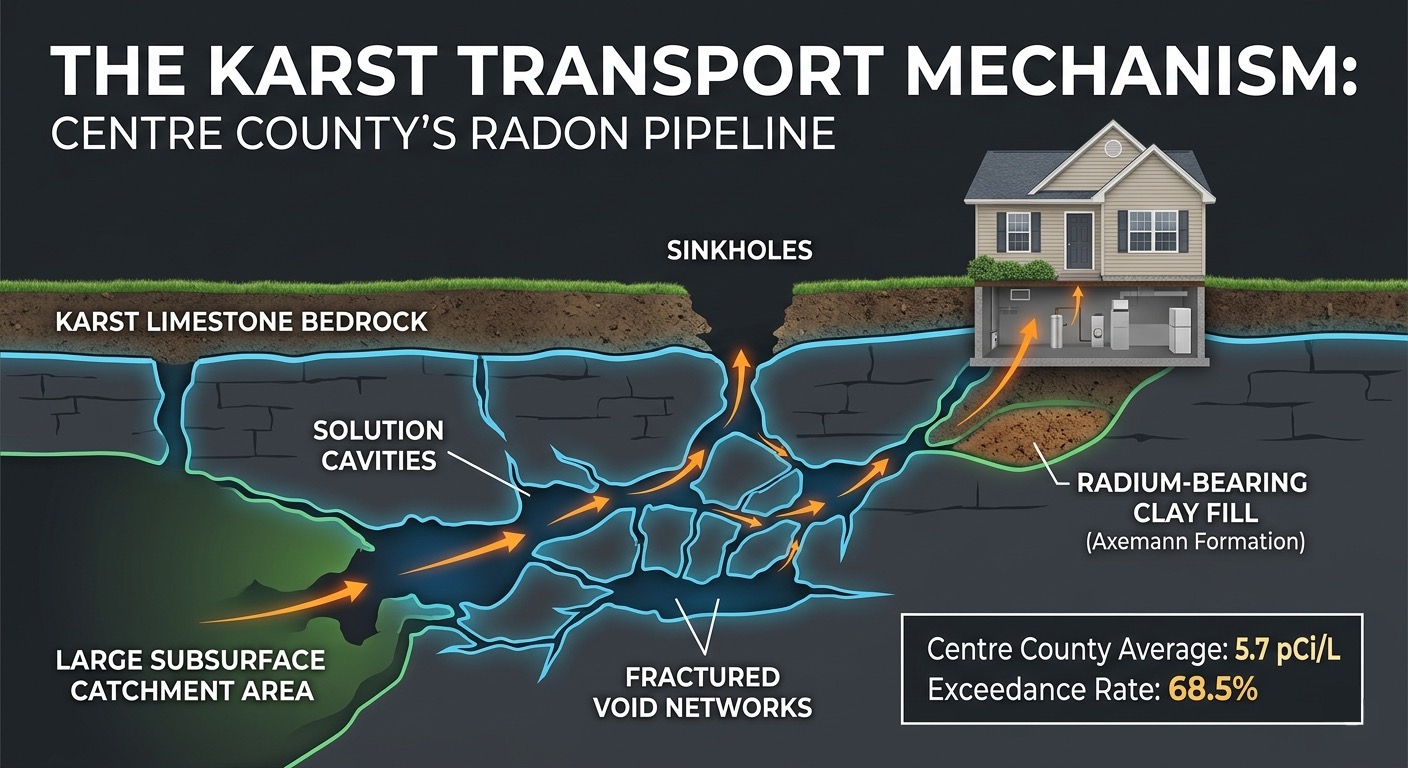
The Karst Transport Mechanism. In Central PA, subsurface void networks and radium-bearing clay fill allow radon to migrate from large catchment areas into homes, leading to the state's highest exceedance rates.
Testing data:
- State College (Centre County): 68.5% exceedance rate, 5.7 pCi/L average — the highest county-level rate in Pennsylvania
- Bellefonte (Centre County): 64.2% exceedance, 5.4 pCi/L — Spring Creek valley karst
- Philipsburg (Centre County): 52.3% exceedance, 4.5 pCi/L — Appalachian Plateau/Ordovician transition
Centre County's 68.5% exceedance rate at State College is the highest of any city in the PA Radon Hub dataset — higher even than Reading. The karst transport mechanism, not just source rock uranium content, is what produces these extreme numbers.
3. The Marcellus Shale: Western Pennsylvania's Radon Baseline
The Marcellus Shale is the most geographically extensive radon source in Pennsylvania, underlying much of the western and north-central portions of the state.
Lithology. The Marcellus is a Middle Devonian-age (approximately 385–390 million years old) black shale formation, deposited in an anoxic marine basin. It is rich in organic carbon and contains naturally elevated concentrations of uranium — the same uranium that makes it a target for natural gas extraction also makes it a significant radon source.
Why it affects indoor radon. The Marcellus Shale's radon contribution is more diffuse than the Reading Prong's. Rather than concentrated high-flux pathways through fractured granite, the Marcellus delivers radon through a broader zone of moderately elevated soil gas across the Appalachian Plateau. The shale weathers to produce clay-rich soils that can retard gas transport somewhat, but the uranium content of the parent rock ensures that soil radon concentrations remain consistently above background levels.
In western Pennsylvania, the Marcellus's radon contribution is amplified by the region's housing stock. Pittsburgh and surrounding Allegheny County have a large inventory of pre-1960 homes with porous foundations, minimal vapor barriers, and unfinished basements — conditions that maximize radon entry rates regardless of source rock concentration.
The stack effect. Western Pennsylvania's cold winters intensify the problem. When a home is heated, warm air rises and exits through the upper floors and attic, creating negative pressure in the basement. This draws soil gas — including radon — through every crack, joint, and pore in the foundation. The "stack effect" is strongest during the months when windows are sealed and heating systems run continuously, which is why winter radon levels in Pittsburgh-area homes can be 2–3 times higher than summer levels.
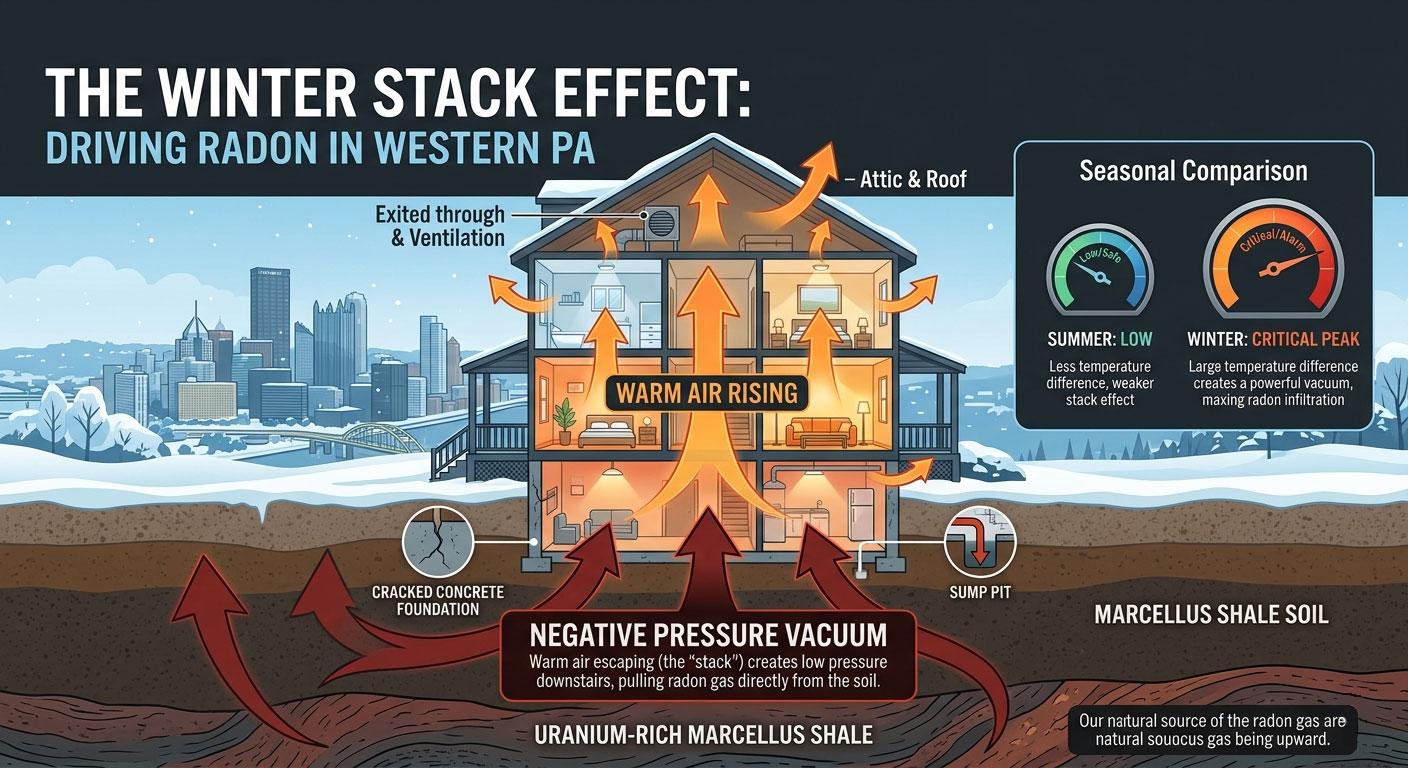
The Winter Stack Effect. In Western Pennsylvania, negative pressure caused by rising warm air creates a vacuum that pulls radon from the Marcellus Shale through foundation cracks, peaking during the heating season.
Testing data:
- Pittsburgh (Allegheny County): 35.8% exceedance rate, 3.2 pCi/L average
- Scranton (Lackawanna County): 31.8% exceedance, 2.8 pCi/L — Appalachian Plateau/anthracite transition
- Erie (Erie County): 29.6% exceedance, 2.6 pCi/L — glacial till over Appalachian Plateau shale
- Warren (Warren County): 30.1% exceedance, 2.7 pCi/L — Allegheny River corridor
These exceedance rates are lower than the Reading Prong or karst zones, but they apply to a vastly larger population base. In absolute numbers, the Marcellus Shale zone likely affects more Pennsylvania homes than any other single formation.
4. The Great Valley and Ridge and Valley Province: Carbonate Corridors
The Great Valley — a broad lowland running from the Delaware River southwest through the Lehigh Valley, across the Susquehanna, and into the Cumberland Valley — is underlain by Cambrian and Ordovician carbonates (limestone and dolomite) that host moderate to high radium concentrations.
Why it matters. The Great Valley carbonates share the karst transport characteristics of the Centre County system but are typically less intensely dissolved. The result is intermediate radon risk — higher than the Appalachian Plateau shale zones but generally lower than the Reading Prong core or the Centre County karst extremes.
The Ridge and Valley province, which flanks the Great Valley to the north and west, adds complexity. Alternating ridges of resistant sandstone and quartzite with valleys of more soluble carbonate create a striped pattern of high-risk valley floors and lower-risk ridge tops. A home's position relative to these ridge-valley contacts can shift its radon risk category dramatically within a distance of less than a mile.
Testing data:
- Carlisle (Cumberland County): 47.3% exceedance, 4.1 pCi/L — Great Valley limestone/Blue Ridge transition
- Lock Haven (Clinton County): 44.8% exceedance, 3.9 pCi/L — Appalachian Valley Ordovician limestone
- Harrisburg (Dauphin County): 33.4% exceedance, 2.9 pCi/L — Triassic Lowland/Blue Ridge transition
- Stroudsburg (Monroe County): 33.7% exceedance, 3.0 pCi/L — Pocono Plateau/Ridge and Valley transition
5. Anthracite and Bituminous Coal Basins: Mining Legacy Geology
Pennsylvania's coal mining history adds a unique variable to its radon landscape. Abandoned mine workings — shafts, tunnels, and subsidence zones — create artificial fracture networks and void spaces that can dramatically alter soil gas migration patterns compared to undisturbed bedrock.
The Wyoming Valley anthracite basin (Luzerne and Lackawanna counties) is the clearest example. The Pennsylvanian-age shales and sandstones that host the anthracite seams contain moderate uranium concentrations. But the extensive network of abandoned mine workings beneath cities like Wilkes-Barre and Pittston creates subsurface air circulation patterns that can either concentrate or disperse radon gas unpredictably. A home built over a collapsed mine void may receive radon from a much larger catchment area than its surface footprint would suggest.
Testing data:
- Wilkes-Barre (Luzerne County): 34.2% exceedance, 3.0 pCi/L — Wyoming Valley anthracite basin
- Pittston (Luzerne County): 32.6% exceedance, 2.9 pCi/L — Wyoming Valley mine-altered shale
- Carbondale (Lackawanna County): 30.4% exceedance, 2.7 pCi/L — northern anthracite field
- Scranton (Lackawanna County): 31.8% exceedance, 2.8 pCi/L — Appalachian Plateau/anthracite transition
The mining legacy means that standard geological predictions based on bedrock type alone may underestimate risk in these areas. Subsurface investigations and professional radon testing are essential in any home within a mapped coal basin — regardless of EPA zone classification.
How Geology Drives Radon Into Buildings
Understanding the source rock is only half the equation. The radon must travel from the rock or soil into the building envelope. Three transport mechanisms dominate in Pennsylvania:
Pressure-Driven Soil Gas Flow
The dominant entry mechanism for radon in most Pennsylvania homes is pressure-driven flow of soil gas through cracks and openings in the foundation. Buildings typically operate at slightly negative pressure relative to the surrounding soil — caused by the stack effect (warm air rising), mechanical exhaust fans, and HVAC system imbalances. This pressure differential draws soil gas, including radon, through any available pathway: slab cracks, cold joints between the slab and foundation wall, utility penetrations, sump pits, and hollow-block wall cores.
The magnitude of this effect depends directly on the sub-slab soil permeability, which is a function of geology. Coarse glacial gravels (common in Erie County and the northern tier) have high permeability and allow large volumes of soil gas to flow in response to small pressure differentials. Dense clay soils (common over weathered Marcellus Shale in western PA) have lower permeability but can still transmit significant radon if fractures in the underlying bedrock provide a gas reservoir.
Diffusion Through Concrete
Concrete is not gas-tight. Radon can diffuse directly through an intact concrete slab, though this pathway typically contributes less radon than pressure-driven flow through cracks. The diffusion rate depends on the concrete's porosity, moisture content, and thickness. Older concrete — particularly the lower-quality mixes used in pre-1960 Pennsylvania homes — is more porous and permits higher diffusion rates.
Groundwater Transport
Radon is soluble in water. Groundwater that has been in contact with radium-bearing rock can carry dissolved radon into a home via well water. When the water is agitated — in showers, washing machines, or dishwashers — dissolved radon is released into indoor air. This pathway is most significant in homes on private wells drawing from fractured bedrock aquifers in the Reading Prong and karst limestone regions, where groundwater radon concentrations can be extremely high.
Municipal water supplies are rarely a significant radon source because the water treatment and distribution process allows most dissolved radon to escape before delivery.
Limestone Voids and the Lehigh Valley
The Lehigh Valley — encompassing Allentown, Bethlehem, and Easton — represents a geological transition zone where Reading Prong influence overlaps with Great Valley carbonate geology. This overlap creates compound radon risk: uranium-rich source rocks feeding into karst-enhanced transport pathways.
Why Limestone Increases the Stack Effect
Karst limestone bedrock behaves differently from crystalline rock or shale when it interacts with building foundations. The solution cavities and widened joints in limestone can function as a natural duct system, connecting the sub-slab soil gas environment to a much larger volume of radon-bearing air than the immediate foundation area would contact in non-karst settings.
When the building's stack effect creates negative pressure in the basement, it draws air not just from the soil directly beneath the slab, but from this extended karst network. The result is that limestone-founded homes can experience radon levels that seem disproportionate to the parent rock's uranium content, because the transport system is so efficient.
The Lehigh Valley Data
- Allentown: 51.2% exceedance — Reading Prong/limestone-dolomite karst dual geology
- Bethlehem: 49.8% exceedance — Reading Prong/Lehigh Valley limestone contact
- Easton: 46.7% exceedance — Delaware River limestone transition zone
These cities sit at the geological boundary where the Reading Prong's crystalline basement dips beneath the Great Valley's carbonate cover. Homes in this transition zone can be affected by both the Reading Prong's high uranium flux and the carbonate system's efficient transport — a worst-of-both-worlds scenario.
Can Construction and Land Disturbance Increase Radon?
Yes. Several mechanisms can alter the local radon landscape:
New Construction on Undisturbed Sites
Excavation for foundations exposes fresh rock surfaces and disturbs natural soil gas pathways. In karst terrain, excavation can open sealed fractures or intersect solution cavities that were previously disconnected from the surface. New construction in Centre County and the Lehigh Valley should always include radon-resistant new construction (RRNC) techniques per ANSI-AARST CC-1000 — a requirement that SB 760 now mandates for new school buildings.
Adjacent Development
Construction activity on neighboring lots can alter sub-surface drainage and gas flow patterns. Vibration from heavy equipment, changes in grading, and disruption of soil horizons can temporarily increase radon flux to adjacent homes. Homeowners in active development areas — particularly in karst limestone zones — should consider periodic retesting during and after nearby construction.
Land Disturbance and Marcellus Shale Drilling
The question of whether hydraulic fracturing for natural gas in the Marcellus Shale increases residential radon levels has been studied with mixed results. Some peer-reviewed studies have found statistical correlations between proximity to gas wells and elevated indoor radon, while others have not. The mechanism is plausible — drilling and fracturing create new pathways in a formation that is already a documented radon source — but the magnitude and consistency of the effect remain scientifically debated.
What is not debated: the Marcellus Shale itself is a significant radon source regardless of drilling activity. Homes in western and north-central Pennsylvania should be tested for radon irrespective of their proximity to gas wells.
EPA Zone Classifications: What They Do and Don't Tell You
The EPA's Map of Radon Zones classifies every county in the United States into one of three zones based on predicted average indoor radon screening levels:
- Zone 1 (highest potential): predicted average ≥ 4 pCi/L
- Zone 2 (moderate potential): predicted average 2–4 pCi/L
- Zone 3 (low potential): predicted average < 2 pCi/L
In Pennsylvania, 37 of 67 counties are classified as Zone 1 — the highest proportion of any state. An additional 23 counties are Zone 2. Only 7 counties are Zone 3.
What the zone map misses
EPA zones are county-level averages based on data from the 1980s and 1990s. They do not account for within-county geological variation, which in Pennsylvania can be extreme. A Zone 2 county like Dauphin (Harrisburg) contains both low-risk Triassic Lowland areas and high-risk Blue Ridge carbonate pockets. A home in the wrong neighborhood of a Zone 2 county can easily exceed the radon levels found in the average Zone 1 home.
The zone map is a screening tool, not a risk assessment. The EPA and PA DEP both recommend testing every home regardless of zone — and the geological reality supports that recommendation. No zone classification exempts a Pennsylvania home from radon risk.
What This Means for SB 760 School Compliance
Senate Bill 760 mandates radon testing in all Pennsylvania public school buildings beginning in the 2026-2027 school year. The geological analysis in this article directly informs compliance priorities:
Highest-urgency districts are those on Zone 1 karst limestone and Reading Prong geology — Centre County (State College, Bellefonte), Berks County (Reading, Kutztown), Lehigh County (Allentown), and Northampton County (Bethlehem, Easton). These districts should expect a high percentage of buildings to test above 4.0 pCi/L and should plan for mitigation timelines (six months from confirmatory testing) and budgets accordingly.
Moderate-urgency districts include those on Marcellus Shale and anthracite basin geology — Allegheny County (Pittsburgh), Luzerne County (Wilkes-Barre), Lackawanna County (Scranton), and Erie County. Exceedance rates in the 29–36% range mean fewer buildings will require mitigation, but the volume of testing across large districts remains significant.
Mining-legacy districts (Luzerne, Lackawanna, Schuylkill counties) face additional complexity: abandoned mine workings can create unpredictable radon pathways that standard geological predictions may not capture. These districts should budget for more extensive diagnostic testing.
For comprehensive SB 760 compliance details — including testing protocols, mitigation timelines, and public reporting requirements — see our Pennsylvania Radon Compliance 2026 guide.
Testing Recommendations by Geological Region
Every Pennsylvania home should be tested for radon. But the geological context determines how urgently and how frequently:
Reading Prong counties (Berks, Lehigh, Northampton, Montgomery, Bucks, Chester): Test immediately if you haven't. Retest every 2 years or after any foundation work. Short-term screening is acceptable for initial assessment, but long-term monitoring (90+ days, e.g., Airthings View Plus) provides a more accurate annual average. Expect a high probability of results above 4.0 pCi/L.
Karst limestone counties (Centre, Huntingdon, Blair, Mifflin, Cumberland): Same urgency as Reading Prong. Be aware that karst geology produces extreme variability — your neighbor's test result has limited predictive value for your home. Test your specific home, not your zip code.
Marcellus Shale / Appalachian Plateau counties (Allegheny, Westmoreland, Washington, Erie, Crawford, Warren): Test all homes. Winter testing (November–March) is most informative because the stack effect is strongest. Even moderate exceedance rates (29–36%) across a large housing stock mean hundreds of thousands of homes are affected.
Coal basin counties (Luzerne, Lackawanna, Schuylkill, Carbon): Test all homes, with particular attention to properties on or near mapped mine workings. Retesting after subsidence events or unusual groundwater changes is prudent.
Triassic Lowland / Piedmont (York, Lancaster, Dauphin): Lower average risk but not zero. Test all homes. Pay attention to local geology — some neighborhoods sit on carbonate pockets within the generally lower-risk Triassic basin.
All testing should follow ANSI-AARST protocols. All mitigation must be performed by individuals certified under Pennsylvania's Radon Certification Act by the Department of Environmental Protection. For a list of DEP-certified professionals in your area, visit our provider directory.
Connecting you with DEP-certified professionals across Pennsylvania. We are an independent resource and do not perform testing or mitigation.
View Certified Providers →
PA Radon Hub is an independent informational resource. We do not perform radon testing or mitigation. We connect homeowners and institutions with independent, DEP-certified radon professionals. Always verify contractor certifications through the PA Department of Environmental Protection before hiring. EPA action level: 4.0 pCi/L. Costs and availability vary by contractor and property conditions.